
Steel Pipes & Tubes for Steel Structures
An engineering reference for buyers of structural hollow sections — grades and dimensions, cold-formed versus hot-finished routes, connection design, corrosion and fire protection, and the full code and testing matrix for steel buildings, bridges, stadiums and towers, all on one page.
Why Hollow Sections Dominate Modern Steel Frames
Four-way symmetry, torsional stiffness and less surface to protect.
Structural hollow sections (HSS) — round (CHS), square (SHS) and rectangular (RHS) tubing — are the preferred steel shape wherever axial load, bending and torsion combine. Their closed cross-section gives four-way symmetry, high torsional stiffness and roughly 20–30% less surface area than an equivalent open section, which translates directly into lower painting, fire-proofing and maintenance cost over the life of the structure.
HSS are produced by cold-forming and welding strip (ERW/HFW), by forming plate into large rectangular and circular sections (LSAW), by spiral welding (SSAW) for very large diameters, or as seamless tubing for thick-wall and special cases. The grade, the manufacturing route and the surface protection together decide what the section is allowed to do in the frame — the rest of this page walks through each decision, anchored in ASTM A500/A1085, EN 10219/10210, JIS G3466 and GB/T 6728.
HSS are not just ‘tubing’ — they are a structural system advantage. The four cards below weigh a closed section against an open I/W shape on the properties that drive most frame decisions — symmetry, torsion, surface cost and looks, and what each one means on site and in the estimate.
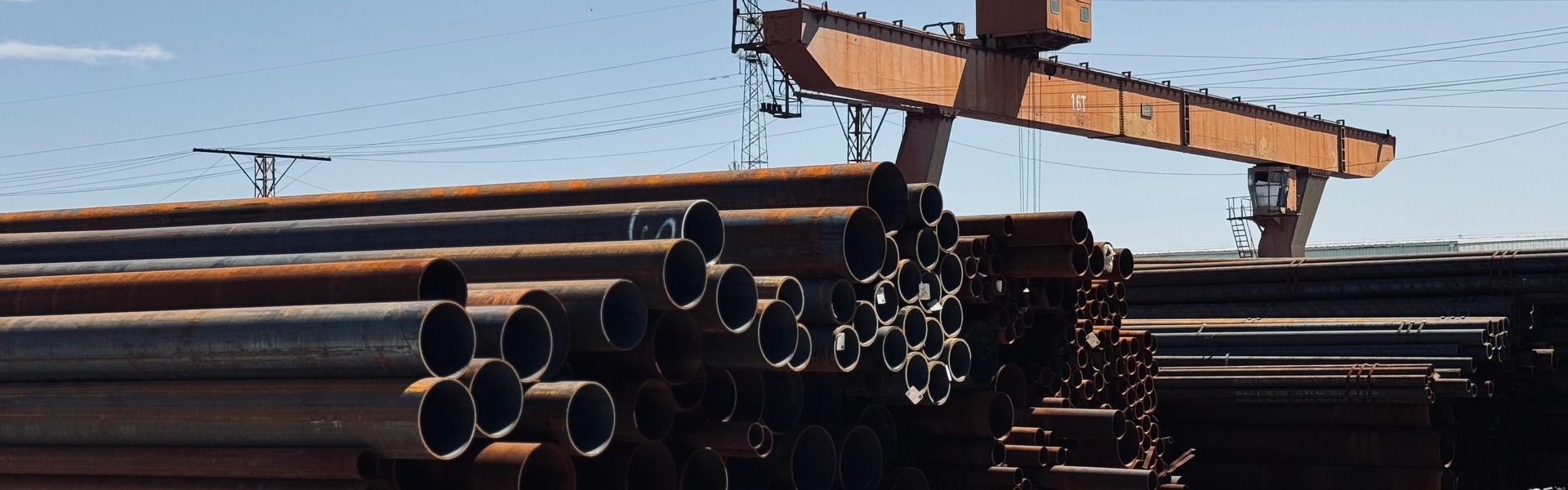
Structural steel frame: HSS columns, trusses and bracing on a commercial build.
Four reasons engineers specify HSS
Click through to the detail cards below
Four-way symmetry
An HSS has the same radius of gyration about both axes, so compression and bending capacity are similar in every direction — ideal for biaxial columns and bracing.
- Key specifications
- • r_x ≈ r_y for SHS/CHS
- • No weak-axis penalty
- • Compact, predictable buckling
Torsional rigidity
The closed section resists twist far better than an open I or W shape, which matters for curved roofs, sign structures and crane-runway brackets.
- Key specifications
- • ~2× stiffness vs I-beam
- • No warping torsion
- • Stable under eccentric load
Less surface area
For the same weight, an HSS presents 20–30% less perimeter than an open section, so paint, galvanizing and intumescent fire coating cost less per tonne.
- Key specifications
- • 20–30% less perimeter
- • Lower coating cost
- • Lower life-cycle maintenance
Aesthetic, clean lines
Exposed HSS reads as a single clean member with no flange tips or cope holes — the default choice for architecturally exposed structural steel (AESS).
- Key specifications
- • AESS-friendly
- • Fewer connections shown
- • Smooth facades & atriums
The Three Hollow Forms: RHS, SHS, CHS
Same steel, three cross-sections — pick by load and look.
All three are made from the same grades and the same manufacturing routes — the difference is the forming die and the end use. RHS is the default for frames; SHS for columns where load is biaxial; CHS where torsion, aesthetics or a welded node dominates.
Typical size ranges
Cold-formed (EN 10219) covers most building HSS; spiral welding reaches 2540 mm OD
| Form | Typical size range | Where it fits best |
|---|---|---|
| RHS (rectangular) | 40×20 – 500×300 mm | Columns, beams, trusses, bracing — the all-rounder |
| SHS (square) | 20×20 – 400×400 mm | Biaxial columns, sign & canopy structures, bollards |
| CHS (circular) | OD 21.3 – 610 mm (ERW); up to 2540 mm (spiral) | Towers, masts, arches, nodes, exposed feature members |
Six Service Environments for Structural Tubing
Span, load, drag, corrosion or modularity — pick the driver.
From a stadium roof to a warehouse column to an offshore module, the same HSS family serves very different structures. Below are the six service environments we see most often — each pushes a different parameter to the front: span, biaxial load, wind drag, corrosion or modular assembly.
Long-span roofs & stadiums
Spatial trusses, arches and reticulated domes where CHS nodes and RHS chords keep weight down while carrying long spans and crowd loads.
- Key specifications
- • CHS K/T/Y nodes
- • RHS chords & ties
- • EN 1993-1-1 / AISC 360
Commercial & industrial buildings
Columns, lattice girders and bracing in SHS/RHS profiles give a compact, clean frame that is fast to erect and cheap to fire-protect.
- Key specifications
- • SHS/RHS columns HSS6–HSS14
- • Braced bays
- • ≤ 50 m clear span typical
Towers, masts & facades
Telecom and lighting towers, glazed facade sub-frames and canopies use tapered and straight CHS/SHS for stiffness with minimal wind drag.
- Key specifications
- • CHS tapered masts
- • SHS facade mullions
- • Galvanized or duplex
Bridges & footbridges
Pedestrian footbridges and road-bridge arches use CHS/RHS in weathering or galvanized steel, often with welded nodes for a clean deck edge.
- Key specifications
- • CHS arches & hangers
- • RHS deck edge beams
- • EN 1993 / AASHTO
Offshore & modular units
Topside modules, mezzanines and skid frames use S355 / higher grades in RHS/CHS for stiffness per tonne and easy bolted assembly offshore.
- Key specifications
- • S355J2H / S420MH
- • Bolted modular frames
- • EN 1090 EXC3
Equipment & rack structures
Conveyor trestles, equipment frames and high-bay racking use standardized RHS/SHS for predictable capacity and fast connection to brackets.
- Key specifications
- • RHS chords & posts
- • Bolted connections
- • ISO 1461 galvanized
Steel Grades for Structural Tubing
Fy drives the allowable stress; impact class drives the climate.
The grade sets the allowable stress, the weld procedure and the low-temperature behaviour. A500 Gr.C and A1085 both sit at 345 MPa minimum yield; EN 10219 S355J2H is the European equivalent with a -20 °C Charpy requirement. For arctic or fatigue-critical nodes, step up to S355K2H (40 J at -20 °C) or hot-finished S355NLH (27 J at -50 °C).
Grade comparison table
ASTM A500 / A1085 · EN 10219 / 10210 · JIS G3466 · GB/T 6728
| Grade | Fy min (MPa) | Fu (MPa) | Impact | Notes |
|---|---|---|---|---|
| ASTM A500 Gr.B | 317 (46 ksi) | 400 (58 ksi) | Not required | Round & shaped HSS, general use |
| ASTM A500 Gr.C | 345 (50 ksi) | 427 (62 ksi) | Not required | Higher-strength HSS workhorse |
| ASTM A1085 | 345 – 485 (50–70 ksi) | 450 (65 ksi) | 34 J @ +4 °C | Tight tolerances, full Fy usable |
| ASTM A501 Gr.B | 315 (46 ksi) | 448 (65 ksi) | 27 J @ -18 °C (Gr.B, t > 8 mm) | Hot-formed alternative |
| EN 10219 S235JRH | 235 | 360 – 510 | 27 J @ +20 °C | General cold-formed HSS |
| EN 10219 S275J2H | 275 | 410 – 560 | 27 J @ -20 °C | Cold climate, seismic bracing |
| EN 10219 S355J2H | 355 | 470 – 630 | 27 J @ -20 °C | Cold-formed high strength |
| EN 10219 S355K2H | 355 | 470 – 630 | 40 J @ -20 °C | Low-temp / fatigue critical |
| EN 10210 S355NH | 355 | 470 – 630 | 40 J @ -20 °C | Hot-finished (normalized) |
| EN 10210 S355NLH | 355 | 470 – 630 | 27 J @ -50 °C | Arctic / low-temperature hot-finished |
| JIS G3466 STKR400 | ~235 | 400 min | Per spec | Japan civil / architectural tubing |
| JIS G3466 STKR490 | ~315 | 490 min | Per spec | Japan higher-strength tubing |
| GB/T 6728 Q235 | 235 | 370 – 500 | Per spec | China cold-formed sections |
| GB/T 6728 Q355 | 355 | 470 – 630 | Per spec | China high-strength sections |
Manufacturing Routes for Structural Tubing
Four processes, one frame spec — choose by diameter and wall.
Four processes — ERW, LSAW, SSAW and seamless — between them cover the entire structural tubing range. Building HSS is almost always ERW; large bridge and tower members are LSAW; the biggest stadium arches and masts are spiral-welded CHS.
Process comparison
Match the process to the diameter, wall and tolerance the frame needs
| Process | Typical OD | Wall | Joint | Where it fits |
|---|---|---|---|---|
| ERW / HFW | 20 – 610 mm | 1.5 – 16 mm | Straight seam, flash-welded | Building HSS, SHS/RHS/CHS |
| LSAW (UOE/JCOE) | 400 – 1500 mm | 6 – 40 mm | Straight seam, SAW | Large RHS, bridge & tower members |
| SSAW (spiral) | 219 – 2540 mm | 6 – 25 mm | Helical seam, SAW | Very large CHS, stadium arches, masts |
| Seamless (SMLS) | 10 – 660 mm | 2 – 80 mm | Single length, no weld | Thick-wall, special & high-pressure |
Wall Thickness & Dimensional Tolerances
Wall sets capacity; tolerance sets how you calculate it.
Wall thickness drives both capacity and cost. Note the AISC 360 rule for cold-formed A500: use 0.93 × nominal wall for section properties because the tolerance is ±10%. A1085 removes that factor with a tighter +10% / -5% wall tolerance and is preferred for fracture-critical and seismic nodes. Corner radius also matters — cold-formed corners are sharper, which can trigger local-buckling limits sooner than hot-finished.
EN 10219 vs EN 10210 tolerances
Per EN 10219-2 / EN 10210-2 dimensional tables
| Parameter | EN 10219-2 (cold-formed) | EN 10210-2 (hot-finished) |
|---|---|---|
| Outside dimension / OD | ±1% (min ±0.5 mm, max ±10 mm) | ±1% (min ±0.5 mm) |
| Wall thickness — t ≤ 5 mm | ±10% | -10% |
| Wall thickness — t > 5 mm | ±0.5 mm | -10% |
| Mass per metre | ±6% | -6% / +8% |
| Straightness | 0.20% of length (CHS) · 0.15% (SHS/RHS) | 0.20% of length |
| Squareness of sides | 90° ± 1° | 90° ± 1° |
| Twist | 2 mm + 0.5 mm/m | 2 mm + 0.5 mm/m |
| External corner profile | 1.6t – 2.4t (t ≤ 6 mm) | ≤ 3t |
Cold-Formed vs Hot-Finished Hollow Sections
Same shape, different metallurgy — match it to the service.
Both are valid structural hollow sections — the choice is about metallurgy and service. Cold-formed (EN 10219) carries residual stress from forming and has sharper corners, so it is cheaper and fine for static, warm-climate frames. Hot-finished (EN 10210) is normalized during manufacture: lower residual stress, rounded corners, and standard sub-zero impact — the right call for seismic bracing, arctic structures and fatigue-critical nodes.
When to choose which
Cost vs sub-zero toughness vs fatigue — pick by service condition
- • Cold-formed (EN 10219): general buildings, warm climates, best cost
- • Hot-finished (EN 10210): seismic, arctic, fatigue-critical nodes
- • A1085: cold-formed but with AISC 0.93 factor removed + CVN tested
Connection Design: Bolted vs Welded
Bolted for speed, welded for nodes — both per AWS D1.1 / EN 1090.
HSS connections come in two families. Bolted end-plate and bolted-through connections are erected fast with no welding on site — ideal for modular and offshore frames. Welded K/T/Y joints (truss nodes, arches) need careful gap/overlap detail and a full-penetration weld per AWS D1.1; the chord wall must be checked for local failure modes (punching, flexural, shear).
Bolted vs welded HSS connections
Pick by erection method, site condition and whether the member is hot-dip galvanized
| Aspect | Bolted | Welded |
|---|---|---|
| Typical detail | End-plate, through-bolt, or shear tab with a cap plate | Direct K / T / Y gap or overlap joint; CJP or fillet weld |
| Site work | No site welding and no site NDT — fastest erection | WPS / PQR, welder qualification and site NDT required |
| Design reference | AISC 360 Ch. J & K · EN 1993-1-8 | AISC 360 Ch. K · EN 1993-1-8 (Tables 7.8–7.13) |
| Best for | Modular and offshore frames, demountable structures, galvanized members | Truss nodes, arches, fatigue-critical and architecturally flush joints |
| Watch-outs | A hole in the chord wall cuts the net section and distorts the face — add a cap plate or stiffener | Chord-face plastification and punching shear; gap / overlap ratio; weld access inside the node |
What to check at a hollow-section node
Chord and brace capacity checks for RHS / CHS nodes
| Check | Applies to | Governing reference |
|---|---|---|
| Chord face plastification | K / T / Y gap joints on an RHS chord | EN 1993-1-8 Tables 7.8–7.13 |
| Punching shear | Brace axial load into a CHS chord | EN 1993-1-8 Tables 7.8–7.13 |
| Brace effective width | RHS brace welded to an RHS chord | EN 1993-1-8 Tables 7.8–7.13 |
| Chord shear and brace local buckling | K joints with a gap; slender braces | EN 1993-1-8 Tables 7.8–7.13 |
| Gap / overlap geometry | K joints — keep the gap clear of both welds | EN 1993-1-8 (hollow-section joints) |
| Weld capacity at the node | CJP or fillet weld, shop or field | AWS D1.1 Ch. J · EN 1993-1-8 |
| Fatigue class | Cyclic / dynamic nodes (bridges, masts) | EN 1993-1-9 · AISC 360 App. 3 |
Corrosion & Fire Protection
Less surface area — cheaper to coat and to fire-protect.
Because HSS have less surface area than open sections, both corrosion coating and fire protection cost less per tonne. Hot-dip galvanizing (EN ISO 1461) is the default for atmospheric service; a duplex system adds a paint top-coat for coastal or industrial sites. For fire, intumescent coating keeps the clean exposed look, while sprayed SFR or concrete encasement is used where ratings exceed what intumescent can give efficiently.
Coating & fire systems
Pick by atmosphere (ISO 12944 category) and required fire rating
| System | Standard | Where it applies |
|---|---|---|
| Hot-dip galvanizing | EN ISO 1461 / ASTM A123 | Atmospheric & mild-industrial; 40–100 yr protection |
| Duplex (galv + paint) | ISO 12944 / EN ISO 12944-5 | Aggressive industrial & coastal atmospheres |
| Paint only (C2–C5-M) | ISO 12944 | Building interiors, mild / marine atmospheres |
| Intumescent coating | EN 13381-4 / UL 1709 | Fire rating 30–120 min, exposed members |
| Sprayed fire-resistive (SFR) | ASTM E119 / EN 13381-3 | Columns & beams, concealed or exposed |
| Concrete encasement | ACI 216 / EN 1994 | Composite columns, high ratings |
Design Codes & Standard Stacks
AISC 360 + A500 for US, EN 1993 + EN 10219 for EU, JIS/GB for Asia.
HSS design is governed by a stack of codes: the structural steel code (AISC 360 / EN 1993), the welding code (AWS D1.1 / EN 1090) and the project execution class. The four most common references are AISC 360 (US), EN 1993 (EU), AWS D1.1 (welding) and JIS G 3466 / GB/T 6728 (Asia). Material standards (A500 / A1085 / EN 10219) sit underneath these.
Common code stacks
Pick the design code first, the material standard second
| Code | Scope | Where it applies |
|---|---|---|
| AISC 360 (Steel Construction Manual) | US design of HSS columns, beams, braces | US buildings & industrial |
| AISC 341 (Seismic Provisions) | Seismic moment & braced frames with HSS | US seismic zones |
| EN 1993-1-1 (Eurocode 3) | General HSS member & connection design | EU buildings & bridges |
| EN 1993-1-8 | Joints & hollow-section node design | EU welded/bolted nodes |
| EN 1994 (composite) | Concrete-filled HSS columns | EU composite frames |
| AWS D1.1 / D1.5 | Structural welding of HSS & nodes | US shop & field welds |
| EN 1090-2 EXC2/3/4 | Execution class for fabrication | EU CE-marked steelwork |
| JIS G 3466 | Carbon steel square/rectangular tubes | Japan civil / architectural |
| GB/T 6728 / GB 50017 | Cold-formed sections & Chinese design code | China structures |
A Six-Step Specification Guide
From loads and code to connection — the spec the mill needs.
Define loads & code
Axial, shear, moment and the governing code (AISC 360, EN 1993, GB 50017 or JIS). Seismic / arctic adds impact and ductility limits.
Pick the shape
RHS for frames, SHS for biaxial columns, CHS for torsion / nodes / exposed features. Match to the member's dominant load.
Choose the grade
A500 Gr.C / A1085 or EN 10219 S355J2H for most work; S355K2H or hot-finished S355NH for low-temp / fatigue; Q355 for China.
Set wall & tolerances
From capacity, then apply the tolerance rule: 0.93× nominal wall for cold-formed A500 (A1085 removes it). Check compactness limits.
Select route & coating
ERW for building HSS, LSAW/SSAW for large members. Galvanize (EN ISO 1461) or duplex for atmosphere; intumescent for exposed fire rating.
Detail connections
Bolted end-plate for speed, welded CJP K/T/Y nodes for trusses per AWS D1.1 / EN 1993-1-8. Confirm chord wall capacity.
Regional Standards for Structural Hollow Sections
The same box section travels under different names depending on where the project is built. Knowing the cross-equivalences lets one fabrication source serve a global project without grade disputes.
Regional cross-references
Same section, different standard — confirm the grade and the impact class on the order
| Region | Cold-formed | Hot-finished | Notes |
|---|---|---|---|
| Europe | EN 10219 S275J0H / S355J2H | EN 10210 S275J0H / S355J2H | EN 10210 hot-finished offers superior toughness and relaxed corner residual stress |
| USA | ASTM A500 Gr. B / Gr. C (min yield: round 42 / 46 ksi; shaped 46 / 50 ksi) | — (A500 is cold-formed by definition) | A500 is electric-resistance welded; dimension tolerances differ from EN |
| China | GB/T 6728 Q235B / Q355B | — | Q355 is broadly comparable to S355; confirm impact class per project |
Note: For dynamic, seismic or low-temperature structures, specify hot-finished EN 10210 with J2 toughness. The corner regions of cold-formed sections carry strain-hardening and residual stress, which matters exactly where connections are welded.
Quality Assurance: What We Test, and Why
Every line on the MTC ties back to a clause in the spec.
Dimensional & shape
OD / side ±1%, wall ±10%, straightness ≤0.2% L, end squareness ≤2°
- Key specifications
- • Per EN 10219-2 / EN 10210-2 / ASTM A500 §12
Chemical analysis
Heat & product analysis: C, Mn, S, P, CEV where specified
- Key specifications
- • ASTM A751 / EN 10219-1 Annex / JIS G 0404
Tensile
Yield, tensile, elongation on transverse specimens
- Key specifications
- • ASTM A370 / EN ISO 6892-1 / JIS Z 2241
Charpy V-notch
27 J at +20 / 0 / -20 °C by grade; 40 J for K2
- Key specifications
- • EN 10219-1 / ASTM A370 / JIS Z 2242
Weld seam NDT
100% UT or RT on ERW/LSAW/SSAW seam, agreed acceptance
- Key specifications
- • EN ISO 17640 / AWS D1.1 / API 5L §10
Coating / galvanizing
Coating thickness & adhesion; Zn layer mass per class
- Key specifications
- • EN ISO 1461 / ISO 12944 / ASTM A123
MTC & marking
Heat number, grade, size, standard stamp, EN 10204 3.1 cert
- Key specifications
- • EN 10204 / ASTM A500 §22 / JIS G 3466
Standards & Certification Map
A complete HSS specification is a stack of 25+ standards — from the product spec through grade, welding, coating, fire and documentation. The five columns below are the ones our mill & engineering team reach for first; project-specific clauses (seismic, arctic, fatigue) are added on top.
Product standards
- ASTM A500 / A500M — Cold-formed welded carbon steel HSS (Gr. B / C)
- ASTM A1085 / A1085M — HSS with tight tolerances & CVN toughness
- ASTM A501 / A501M — Hot-formed welded & seamless HSS
- EN 10219-1 / -2 — Cold-formed welded structural hollow sections
- EN 10210-1 / -2 — Hot-finished structural hollow sections
- JIS G 3466 — Carbon steel square / rectangular tubes (STKR)
- GB/T 6728 — Cold-formed steel sections for general structures
Material / grade
- EN 10025-2 / -4 — S235 / S275 / S355 · S355M/NL for nodes
- ASTM A36 / A572 — Backing plates, cap plates, stiffeners
- S355K2H / S460NH — Low-temp & fatigue-critical hollow grades
- Q235 / Q355 (GB) — Chinese structural grades for HSS feedstock
Welding & execution
- AWS D1.1 / D1.5 — Structural welding — HSS & nodes
- EN 1090-2 EXC2/3/4 — Execution class for fabricated steelwork
- EN 1993-1-8 — Hollow-section joint & node design
- ISO 3834-2 — Quality requirements for welding
Coating & fire
- EN ISO 1461 — Hot-dip galvanizing of fabricated articles
- ISO 12944 — Paint systems by atmosphere (C2–C5-M)
- EN 13381-4 / -3 — Fire protection (intumescent / SFR)
- ASTM A123 / E119 — US galvanizing & fire-resistance tests
Testing & docs
- EN 10204 3.1 / 3.2 — Mill test certificate
- ASTM A370 / A751 — Mechanical & chemical test methods
- EN ISO 6892-1 — Tensile testing of metallic materials
- ISO 9001 / EN 1090 — Quality system & CE execution
Frequently Asked Questions
Eight questions we hear most often from structural engineers, fabricators and estimators.
What grade should I specify for a building column in a cold climate?
Use EN 10219 S355J2H (27 J at -20 °C) or ASTM A500 Gr.C / A1085 for general work. For arctic or fatigue-critical nodes step up to S355K2H (40 J at -20 °C) or hot-finished S355NLH (27 J at -50 °C). The impact class, not just the yield, should drive the choice.
Do I really need to apply the 0.93 wall-thickness factor?
For cold-formed ASTM A500 yes — AISC 360 requires 0.93 × nominal wall because the tolerance is ±10%. ASTM A1085 removes that factor with a tighter tolerance and is preferred where the reduction would otherwise erode capacity. EN 10219 uses the measured wall.
Can I use spiral-welded (SSAW) pipe as structural CHS?
Yes for large members — stadium arches, masts and bridge hangers up to 2540 mm OD are commonly spiral-welded. Specify the grade (e.g. S355J2H) and the weld-seam NDT (100% UT/RT) explicitly, since SSAW is not covered by A500; reference EN 10219 or the project material spec.
Bolted or welded connections for HSS?
Bolted end-plate or bolted-through for fast, no-weld site erection (modular, offshore). Welded CJP K/T/Y joints for trusses and arches — design the node per AWS D1.1 / EN 1993-1-8 and check chord wall failure modes.
How do I protect HSS against corrosion and fire?
Hot-dip galvanize per EN ISO 1461 for atmosphere; add a paint top-coat (duplex) for coastal / industrial. For fire rating keep the clean look with intumescent coating (EN 13381-4 / UL 1709); use sprayed SFR or concrete encasement above ~120 min. HSS need less coating than open sections.
What documentation comes with a structural HSS delivery?
EN 10204 3.1 mill certificate as standard, third-party 3.2 on request, full heat-number and size traceability, weld-seam NDT reports, and galvanizing / coating certificates where applied.
Why do cold-formed corners matter at connections?
Cold forming strain-hardens the corner radii and leaves residual stress; welded nodes landing on those corners then see reduced local ductility. Hot-finished (EN 10210) sections are heat-treated after forming, relaxing these effects — the reason fatigue- and seismic-sensitive nodes often mandate hot-finished tube.
Can hollow sections be hot-dip galvanized without distortion?
Yes — with vent and drain holes sized to the galvanizer’s guidance. Sealed hollow sections build internal pressure at the ≈ 450 °C zinc bath temperature, which is why venting is mandatory. We can supply HSS with pre-drilled venting or agree hole positions with your galvanizer before delivery.
Why Buyers Choose CREATEEL for Structural Tubing
Mill + grade coverage + coating + node engineering, in one contract.
Mill-direct HSS
Our mills run ERW, LSAW and spiral lines, so quotes are mill-direct — RHS/SHS/CHS in one supply contract, not re-routed through a stockist.
Full grade coverage
ASTM A500 / A1085 / A501, EN 10219 / 10210, JIS G3466 and GB/T 6728 — one mill for structures shipped to the US, EU, Middle East, Asia and Japan.
Tight tolerances & CVN
We supply A1085-equivalent tight-tolerance HSS with mandatory Charpy testing for seismic and low-temperature projects, not just the commercial A500 minimum.
Coating integration
Hot-dip galvanizing per EN ISO 1461 and duplex paint systems are applied on the same yard as the rolling mill — no double handling, single quality record.
Connection engineering
Node design, bolted end-plate and CJP welded K/T/Y details per AWS D1.1 / EN 1993-1-8 at no extra cost for the first 200 t of each project.
Documentation for spec
EN 10204 3.1 certificate, third-party 3.2 on request, full heat-number and weld-NDT traceability for the whole delivery.
Related CREATEEL Products
Every structural HSS project is supported by the mill’s wider steel-pipe catalogue.

Square Steel Pipe
SHS / RHS hollow sections to EN 10219 / ASTM A500 — columns, chords and bracing members.
View product details →
ERW Steel Pipe
HFW tubing ½″–24″ — the feedstock for most building HSS, SHS and RHS.
View product details →
LSAW Steel Pipe
UOE / JCOE large sections 16″–56″ for bridge members, tower legs and large RHS.
View product details →
SSAW Steel Pipe
Spiral SSAW pipe up to 2540 mm OD — economical large-diameter supply for columns, chords and tower sections.
View product details →
Galvanized Steel Pipe
Hot-dip galvanized finish per EN ISO 1461 / ASTM A123 — long-life corrosion protection for structural members.
View product details →
Viscous Damper
Viscous damping devices for seismic and wind energy dissipation in steel frames.
View product details →Ready to Specify Structural Tubing?
Send us the loads, the shape and the project code — we will come back with a mill-direct quote, the grade and tolerance proposal, and the coating / fire-protection scope for the structure’s design life.
 [email protected] |
  +86 15602135951 |
  WhatsApp Available