
Steel Pipes for Boilers & Pressure Vessels
An engineering reference for buyers of boiler tube and pressure piping — water walls, superheaters and reheaters, main steam and feedwater — with the grades, creep limits, water chemistry and code certificates that keep a boiler on line for its design life.
Code-Built Tube for the Hottest Job in the Plant
Water walls, superheaters, steam mains — one certified supply.
A boiler is a pressure vessel that lives at the edge of the material map: furnace tubes absorb radiant heat at high flux, superheater tubes carry steam at 540–620 °C where carbon steel creeps away, and main-steam piping holds 170–300 bar across a power plant’s life. Every tube is a code part — selected, tested and certified to ASME Section I / Section II and B31.1.
CREATEEL supplies the full boiler-tube and pressure-pipe package from one mill — seamless carbon steel (A192, A210, A106), chrome-moly alloy tube and pipe (A213 T-grades, A335 P-grades), stainless superheater grades and EN 10216-2 equivalents — with heat-treatment records, eddy-current testing and EN 10204 3.1 / 3.2 certification behind every heat number.
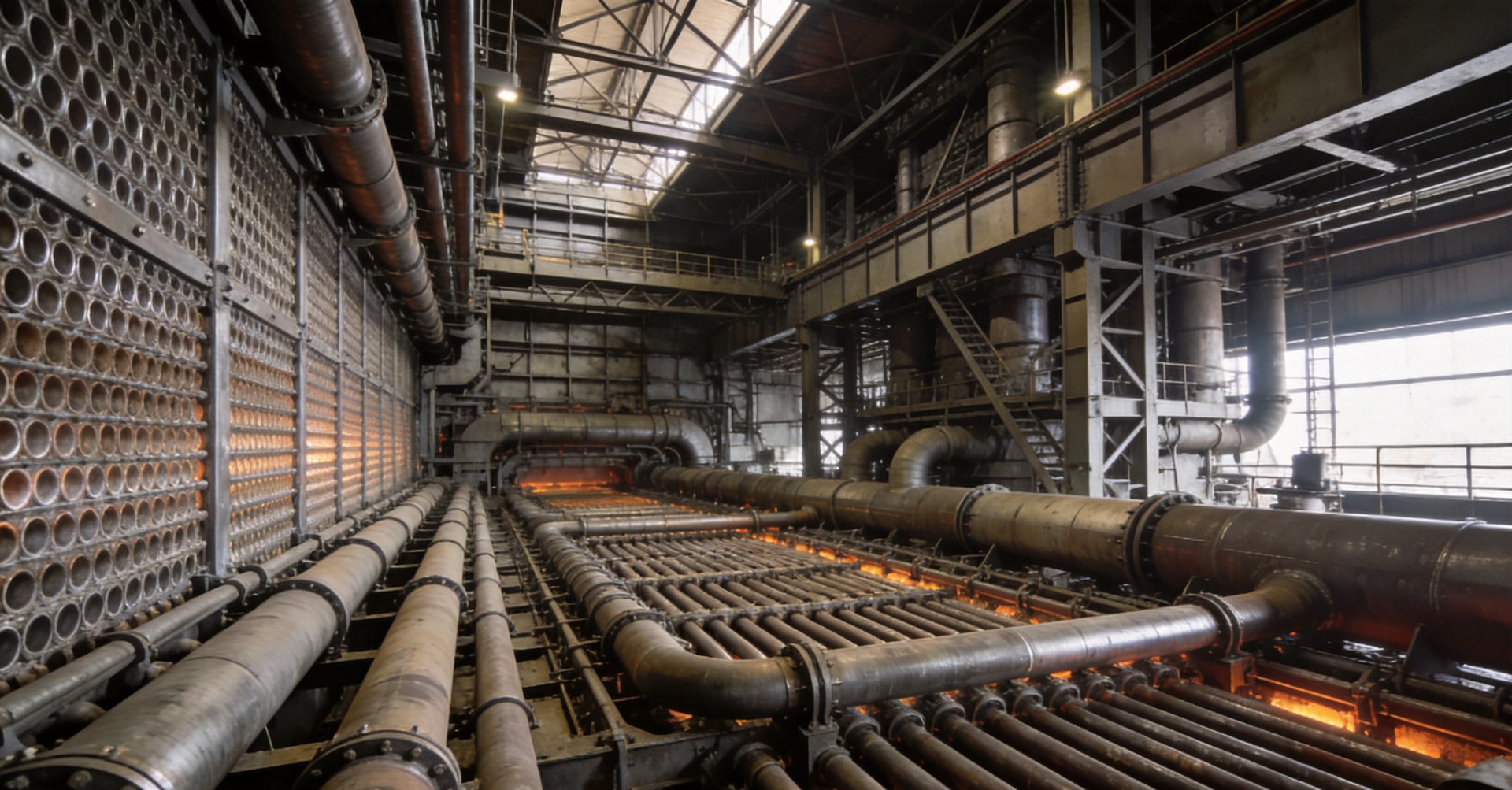
Boiler and pressure-piping plant: water walls, steam drums and heavy-wall mains.
Four Loads That Decide a Boiler-Tube Spec
Creep, pressure, chemistry and certification — in that order.
Four engineering loads decide every boiler-tube spec. Get any one wrong and the result is forced outage — so the rest of this page walks through how grade, wall, chemistry and documentation answer each one.
Creep & temperature
Above ~450 °C carbon steel deforms under load with time — creep. Every grade has a temperature ceiling; over-temperature events silently consume remaining life.
- Key specifications
- • Carbon ceiling ~450 °C
- • P22 to ~575 °C
- • P91 to ~625 °C
Pressure & wall
Section I’s PG-27 formula sizes wall from design pressure, OD and allowable stress at temperature — no corrosion-guess numbers, code minimums only.
- Key specifications
- • t = PD/(2SE+2yP)
- • Allowable stress per Sec. II
- • Code-min wall discipline
Water chemistry
Dissolved oxygen pits tube internals; silica carries into steam; hardness bakes into scale. ASME feedwater limits exist to protect the tube, not just the water.
- Key specifications
- • O₂ < 7 ppb
- • pH 8.3–10.0 (8.8–9.6 HP)
- • SiO₂ ≤150→1 ppm
Certification
Code parts demand full traceability: heat treatment charts, NDT of the seamless body, hydro, flattening and hardness on every lot, 3.1/3.2 MTC.
- Key specifications
- • EN 10204 3.1 / 3.2
- • Heat-treatment charts
- • PMI on alloy grades
Four Duty Zones in Every Boiler
Radiant, superheat, steam mains and vessels — one supplier covers all.
From a 300 MW subcritical island to a 660 MW supercritical unit to a process-plant steam system, the same four duty zones appear — each pushing a different parameter to the front.
Four boiler duty zones
Every steam plant runs the same four tube families — this page covers all of them.
Where each tube family fits
Click through to the detail cards below
Water walls
Furnace radiant panels boil feedwater at high heat flux. OD 25–89 mm tube, 3–8 mm wall, membrane-bar welded into panels.
- Key specifications
- • A192 / A210 Gr.A1
- • T11 at higher duty
- • OD 25–89 mm
Superheaters & reheaters
The hottest tubes in the plant: 450–620 °C steam. Grade follows temperature — T22 through the mid sections, T91 for finals.
- Key specifications
- • A213 T11 / T22 / T91
- • TP347H for USC finals
- • Creep-limited life
Main steam & reheat
Heavy-wall piping from boiler outlet to turbine: 170 bar subcritical on P22, 250 bar supercritical on P91.
- Key specifications
- • A335 P22 / P91
- • OD 21.3–609.6 mm
- • B31.1 designed
Vessels & exchangers
Drums, feedwater heaters and process shells — Section VIII construction on A106 / A516 plate-pipe systems.
- Key specifications
- • A106 Gr.B / Gr.C
- • A179 exchanger tube
- • Section VIII rules
Grades Through the Steam Cycle
Carbon → 1.25Cr → 2.25Cr → 9Cr — follow the temperature.
The steam cycle is a temperature ladder, and the material ladder follows it rung by rung. Carbon steel carries the feedwater and evaporator duty; 1.25Cr and 2.25Cr alloys take the mid-range; the martensitic 9Cr grades own the hottest superheaters and main-steam lines. Stainless (TP304H, TP347H) appears where steam-side oxidation control matters most.
Metal temperature through the steam cycle
The grade must follow the metal temperature, zone by zone.
Grade selection by duty zone
ASTM A192 / A210 / A213 / A335 · stainless finals
| Duty zone | Metal temp | Standard grades |
|---|---|---|
| Economizer | < 400 °C | ASTM A192, A210 Gr.A1 |
| Water walls | 400–450 °C | A192 / A210; T11 at higher flux |
| Primary superheater | 450–540 °C | ASTM A213 T11, T22 |
| Final superheater | 540–600 °C | ASTM A213 T91; TP347H for USC |
| Ultra-supercritical | 600–620 °C | T92, TP347H / TP310H |
| Main steam 540 °C / 170 bar | Subcritical | A335 P22 |
| Main steam 566 °C / 250 bar | Supercritical | A335 P91 |
| Main steam 600–620 °C | Ultra-supercritical | P92 (+ nickel alloys at peaks) |
Steel Grades for Boilers & Pressure Parts
A ladder of grades, each with its own temperature ceiling.
Boiler materials are chosen by temperature, not by strength alone. A192 and A210 are the seamless workhorses inside the boiler; A106 carries the colder pressure piping around it; the A213 T-grades and A335 P-grades step up through the chrome-moly ladder as metal temperature rises. European specifications (EN 10216-2) map onto the same ladder — P265GH, 16Mo3, 13CrMo4-5.
Grade table — the boiler ladder
ASTM A106/A192/A210/A213/A335 · EN 10216-2
| Grade | Type | Fy / Fu (MPa) | Typical service |
|---|---|---|---|
| ASTM A106 Gr.B | Seamless C-steel pipe | 240 / 415 | Feedwater, cold reheat, headers ≤450 °C |
| ASTM A106 Gr.C | Seamless C-steel pipe | 275 / 485 | Higher-pressure feedwater (<300 °C) |
| ASTM A192 | Seamless C-steel tube | 180 / 325 | High-pressure water walls & economizers |
| ASTM A210 Gr.A1 | Seamless C-steel tube | 255 / 415 | Superheater & boiler tubes to ~400 °C |
| ASTM A210 Gr.C | Seamless C-steel tube | 275 / 485 | High-stress boiler zones |
| ASTM A213 T11 | 1.25Cr-0.5Mo tube | 205 / 415 | Water walls, primary SH to ~550 °C |
| ASTM A213 T22 | 2.25Cr-1Mo tube | 205 / 415 | Superheaters & reheaters to ~575 °C |
| ASTM A213 T91 | 9Cr-1Mo-V tube | 415 / 585 | Final SH / RH to ~625 °C, supercritical |
| ASTM A335 P22 | 2.25Cr-1Mo pipe | 205 / 415 | Main steam, subcritical 540 °C / 170 bar |
| ASTM A335 P91 | 9Cr-1Mo-V pipe | 415 / 585 | Main steam, supercritical 566 °C / 250 bar |
| EN 10216-2 P265GH | C-steel pressure tube | 265 / 410-530 | European pressure duty to 400 °C |
| EN 10216-2 13CrMo4-5 | 1.25Cr-0.5Mo | 280 / 440-590 | EU equivalent of T11 / P11 |
T91 / P91 quick facts
The grade that redefined main steam
- • 9Cr-1Mo-V martensitic, normalized + tempered
- • ~100 MPa creep-rupture at 600 °C / 100,000 h (P22: ~60)
- • Thinner walls than P22 → less thermal stress
- • Demands strict PWHT & hardness control
- • Supplied with time-temperature charts
Creep & High-Temperature Life
Grade sets the ceiling; operation decides how fast you reach it.
Creep is time-dependent deformation under stress at temperature — the defining failure mode of boiler materials. Grade selection is really creep-life selection: P91 delivers roughly double the 100,000-hour rupture strength of P22 at 600 °C, which is why it became the default for supercritical main steam. But creep life is consumed by events, not just hours — every over-temperature excursion, every unqualified weld heat treatment, every oxide-driven temperature rise takes a bite the logbook never shows.
100,000-hour creep-rupture strength @ 600 °C
Why P91 replaced P22 on modern main-steam lines.
Creep-life management
Design, monitor and document — in that order
| Factor | Effect on creep life | Countermeasure |
|---|---|---|
| Over-temperature events | Short excursions consume disproportionate life | Design for realistic peak, alarm on exceedance |
| Wall thinning | Higher stress at constant pressure | UT thickness monitoring at known wear points |
| Steam oxidation | Scale raises metal temperature | 9Cr grades / TP347H inlays for steam-side control |
| Weld joints (Type IV) | Creep-weak zone in HAZ of ferritic welds | Qualified PWHT, hardness survey per B31.1 |
| Startup / shutdown cycles | Thermal fatigue at heavy-wall sections | Controlled ramp rates, P91 wall-thickness care |
Sizes: Boiler Tube to Main-Steam Header
19 mm superheater elements to 610 mm heavy-wall P91.
One order can span a millimetre-scale superheater element and a metre-scale main-steam header. Boiler tube runs small but thick-walled with tight tolerances; A335 pipe runs to 610 mm OD in heavy schedule walls. Seamless manufacturing dominates this page for a reason — the code prefers a pipe body without a weld seam at these pressures.
Outside-diameter coverage by product family
Boiler tube, exchanger tube and heavy-wall A335 pipe from one mill.
Size & product matrix
Match product family to duty zone
| Product | Standard | Typical size range |
|---|---|---|
| Boiler tube (seamless) | ASTM A192 / A210 / A213 | OD 19–127 mm, wall 2–14 mm |
| Heat-exchanger tube | ASTM A179 / A213 | OD 15.9–76.2 mm |
| Water-wall panel tube | A192 / A210, membrane-welded | OD 25–89 mm, wall 3–8 mm |
| Alloy pressure pipe | ASTM A335 P5–P92 | OD 21.3–609.6 mm, heavy wall |
| Carbon pressure pipe | ASTM A106 Gr.B/C | NPS 1/8–36″, Sch 10–160 |
| EN pressure tube | EN 10216-2 P235GH–13CrMo4-5 | OD 19–610 mm |
Water Chemistry: The Invisible Tube Protection
7 ppb oxygen, tight pH, controlled silica — or lose the creep margin.
Water chemistry is tube protection. A fraction of a millimetre of scale can push tube metal tens of degrees hotter — silently spending creep life and driving circumferential failures. ASME’s feedwater guidelines hold dissolved oxygen below 7 ppb at every drum pressure, keep pH in the 8.3–10.0 band (8.8–9.6 above 1000 psig), and tighten silica and hardness limits as pressure rises. The tube spec and the water spec are one system.
ASME feedwater chemistry limits
Oxygen, pH, silica and hardness — the four dials that protect the tube.
Failure prevention matrix
ASME / ABMA feedwater guidance
| Threat | Mechanism | Control |
|---|---|---|
| Dissolved oxygen | Pitting of tube internals, especially economizer inlet | Deaerator + scavenger; < 7 ppb at all drum pressures |
| Scale / hardness | Insulating deposit → local over-temperature | Softening / RO; hardness ≤0.3 ppm, ND in high-pressure |
| Silica | Volatile carry-over into steam, turbine deposits | Blowdown + limits that tighten from 150 to 1 ppm |
| Iron / copper oxides | Transport corrosion products deposit on hot walls | Condensate treatment; Fe ≤0.1→0.01 ppm |
| Caustic / acid gouging | Concentration cells under deposits | pH control 8.3–10.0 (8.8–9.6 >1000 psig) |
Manufacture: Structure Is the Specification
Seamless bodies, heat-treated to the code’s assumptions, tested to prove it.
Boiler tube is a heat-treatment product. Hot-finished or cold-drawn seamless bodies are annealed or normalized-and-tempered to set the grain structure the code allowable stresses assume — and for T91/P91 the tempered-martensite structure is the creep strength, so the time-temperature chart is part of the certificate. Cold drawing gives the tight OD/wall tolerances superheater elements need; every length then faces hydro, flattening, flare, hardness and eddy-current or UT testing before it ships.
Manufacture & test stack
Heat treatment sets structure; testing proves it
| Process / test | Purpose | Standard |
|---|---|---|
| Hot-finished seamless | Economical larger sizes, uniform structure | A106 / A335 / EN 10216-2 |
| Cold-drawn seamless | Tight tolerance tube for elements | A192 / A210 / A213 / A179 |
| Anneal / normalize + temper | Sets grain structure & allowable stress | Per grade; charts on file |
| Hydrostatic test | Leak integrity of every length | ASTM / ASME per spec |
| Flattening & flare | Ductility & soundness of the tube body | A192 / A210 / A213 requirements |
| Eddy-current / UT | Volumetric NDT of the seamless body | ASTM E213 / E309 / A450 |
| Hardness (esp. P91) | Confirms correct heat treatment | A335 & B31.1 practice |
Why P91 paperwork matters
The heat-treatment record is part of the material
- • Normalize ~1040–1080 °C + temper ~760 °C
- • Hardness band confirms transformation
- • Wrong PWHT = creep life lost before startup
- • We ship time-temperature charts with every lot
Welding & Post-Weld Heat Treatment
The joint must be as code-clean as the tube — especially in P91.
Boiler joints are code joints. Shop and field welding follows ASME Section IX procedures; boiler external piping follows B31.1. Carbon grades weld with E7018-class fillers; T22/P22 need matching 2.25Cr filler and PWHT; P91 is the discipline test — controlled heat input, matched 9Cr filler, mandatory post-weld heat treatment and a hardness survey to prove the joint kept its creep strength. Dissimilar joints (P91 to TP347H) get nickel filler and their own procedure.
Welding & PWHT by grade
ASME IX procedures · B31.1 fabrication
| Grade | Filler approach | PWHT & checks |
|---|---|---|
| A106 / A192 / A210 | E7018 / ER70S-6 class | PWHT per thickness; visual + hydro |
| T11 / P11 (1.25Cr) | Matching 1.25Cr filler | PWHT typically required; hardness check |
| T22 / P22 (2.25Cr) | Matching 2.25Cr filler | PWHT mandatory; RT/UT of joints |
| T91 / P91 (9Cr-V) | Matching 9Cr (e.g. ER90S-B9) | PWHT mandatory + hardness survey |
| P91 ↔ TP347H | Nickel filler (ENiCrFe-3) | Disimilar-metal procedure, UT monitored |
Type IV creep warning
The HAZ is the weak link in ferritic welds
- • Fine-grained HAZ creeps faster than parent metal
- • Service-aged P91 welds need life assessment
- • Hardness survey = cheapest life check
- • Repairs demand re-qualification, not improvisation
Design Codes & Standard Stacks
Section I for the boiler, B31.1 for the piping, EN 10216-2 for Europe.
Boiler work is code work. ASME Section I owns the boiler proper and its external piping, Section II supplies the allowable stresses behind every wall calculation, Section VIII covers the vessels, and B31.1 takes over once steam leaves the boiler envelope. European projects run the same logic on EN 10216-2 materials under the Pressure Equipment Directive. Every line of the MTC traces back into one of these books.
Common code stacks
Pick the component first, the code second
| Code / standard | Scope |
|---|---|
| ASME BPVC Section I | Power boilers — tube design (PG-27) & boiler external piping |
| ASME BPVC Section II | Material allowable stresses (SA-series) |
| ASME BPVC Section VIII | Pressure vessels — drums, exchangers |
| ASME B31.1 | Power piping beyond the boiler proper |
| ASTM A106 / A192 / A210 | Seamless carbon-steel pipe & boiler tube |
| ASTM A213 / A335 | Alloy boiler tube (T-) & pipe (P-) |
| EN 10216-2 | European pressure tube & pipe |
| PED 2014/68/EU | European pressure equipment directive (Cat. II/III) |
| EN 10204 3.1 / 3.2 | Certification of code material |
Standards flow
Product → design → protect → verify
A Six-Step Specification Guide
From duty zone to certificate — the spec the mill needs.
Define the duty zone
Economizer, water wall, superheater, reheat, main steam or vessel — with realistic peak metal temperature.
Pick the grade ladder
A192/A210 to ~450 °C; T11/T22 mid-range; T91/P91 above 540 °C; TP347H where oxidation rules.
Calculate code wall
Section I PG-27: t = PD/(2SE+2yP) with Section II allowable stress at design temperature.
Set heat treatment
Annealed or normalized + tempered per grade; P91 demands documented time-temperature charts.
Plan chemistry & NDT
ASME feedwater limits protect the tube; hydro, flattening, hardness, ET/UT and PMI prove it.
Close the certification
EN 10204 3.1 (3.2 on request), heat-number traceability, PMI on alloys, PED where applicable.
Cr–Mo Grades: Chemistry and Temperature Ceilings
Chromium buys oxidation resistance and creep strength; molybdenum buys high-temperature strength per unit of cost. The Cr–Mo ladder below is the backbone of boiler material selection — each rung raises the metal temperature a tube can carry.
| Grade | Nominal chemistry | Indicative metal-temp ceiling | Where it lives |
|---|---|---|---|
| SA-192 / SA-210 A-1 | C–Mn carbon steel | ≈ 425 °C | Generating bank, waterwall circuits |
| T11 / P11 | 1.25 Cr – 0.5 Mo | ≈ 540 °C | Superheater mid-stages, refinery headers |
| T22 / P22 | 2.25 Cr – 1 Mo | ≈ 565 °C | Superheaters, reheaters, high-pressure headers |
| T91 / P91 | 9 Cr – 1 Mo – V, Nb | ≈ 620 °C | High-temperature superheaters, main-steam lines |
Note: The ceilings are indicative metal-temperature limits for design discussion — ASME Section II holds the stress tables that actually size the wall. The step from T22 to T91 roughly doubles creep strength, letting the same duty run either thinner wall or hotter steam.
Quality Assurance: What We Test, and Why
Every line on the MTC ties back to a clause in the spec.
Dimensional & wall
OD & wall per grade tolerances (A450 / A530); straightness & length
- Key specifications
- • ASTM A450 / A530
Chemical analysis
Heat & product analysis: C, Mn, Cr, Mo, V per grade
- Key specifications
- • ASTM A751
Tensile & yield
Room-temperature tensile per grade (T91: 415/585 MPa)
- Key specifications
- • ASTM A370 / EN ISO 6892-1
Hardness
Brinell / Rockwell bands — the P91 heat-treatment proof
- Key specifications
- • ASTM A370 / A335 practice
Hydrostatic test
Every length pressure-tested for leaks
- Key specifications
- • Per grade / ASME practice
Flattening & flare
Ductility and soundness of the tube body
- Key specifications
- • A192 / A210 / A213
NDT of body
Eddy-current or UT volumetric examination of seamless body
- Key specifications
- • ASTM E213 / E309 / A450
MTC & marking
Heat number, grade, heat-treat lot, EN 10204 3.1 (3.2 opt.)
- Key specifications
- • EN 10204 / PED 2014/68/EU
Standards & Certification Map
A complete boiler-tube specification is a stack of standards — from the material spec through design code, heat treatment, welding qualification and documentation. The five columns below are the ones our mill & engineering team reach for first; project-specific clauses (USC, PED category, TPI witness) are added on top.
Boiler tube
- ASTM A192 / SA-192 — High-pressure seamless C-steel tube
- ASTM A210 Gr.A1 / C — Medium-carbon seamless tube
- ASTM A213 T11 / T22 / T91 — Alloy boiler & superheater tube
- ASTM A178 — ERW C-steel boiler tube
- ASTM A179 / A556 — Exchanger & feedwater-heater tube
Pressure pipe
- ASTM A106 Gr.B / C — Seamless carbon pressure pipe
- ASTM A335 P11 / P22 / P91 / P92 — Ferritic alloy pipe
- ASTM A691 — Fusion-welded pressure pipe
- EN 10216-2 — P235GH / P265GH / 16Mo3 / 13CrMo4-5
Design codes
- ASME BPVC Sec. I — Power boilers, PG-27 wall design
- ASME BPVC Sec. II — Allowable stresses (SA-series)
- ASME BPVC Sec. VIII — Pressure vessels
- ASME B31.1 — Power piping
- PED 2014/68/EU — European pressure equipment
Heat treatment & welding
- ASME Sec. IX — Welding procedure qualification
- Grade PWHT rules — Normalize + temper; P91 charts
- ASTM A988 / hardness — PWHT verification practice
- EN ISO 15614 — European weld qualification
Testing & docs
- ASTM A450 / A530 — General tube / pipe test requirements
- ASTM E213 / E309 — UT / ET of seamless bodies
- ASTM A370 / A751 — Mechanical & chemical test methods
- EN 10204 3.1 / 3.2 — Mill test certificate
- ISO 9001 — Quality system
Frequently Asked Questions
The questions we hear most often from boiler engineers, EPC procurement teams and plant owners.
What is the real temperature ceiling for carbon-steel boiler tube?
Around 450 °C continuous (short peaks to ~480 °C cost design life). Above that, creep becomes the governing mode — step up to T11/T22, then T91/P91 as metal temperature rises. The grade, not the pressure, usually sets the limit.
When should I specify T91 instead of T22?
Above ~540–575 °C metal temperature, or wherever thinner walls reduce thermal stress: T91 carries roughly double the 100,000-hour creep-rupture strength of T22 at 600 °C. It demands documented normalize-and-temper treatment and a hardness survey to deliver that strength.
How is boiler-tube wall thickness calculated?
ASME Section I PG-27: t = PD/(2SE+2yP) using the Section II allowable stress at design temperature. This is a code-minimum calculation — no ad-hoc corrosion allowances — and the design temperature must reflect realistic peaks, not nameplate steam conditions.
Why do you ship heat-treatment charts with P91?
P91’s creep strength comes from its tempered-martensite structure, which only a correct normalize (~1040–1080 °C) and temper (~760 °C) cycle produces. The time-temperature record plus hardness band is the proof the material can carry its allowable stress.
What water chemistry does my tube supplier expect me to run?
ASME feedwater guidance: dissolved oxygen < 7 ppb at all drum pressures, pH 8.3–10.0 (8.8–9.6 above 1000 psig), silica limits tightening from 150 ppm to 1 ppm as pressure rises, and no detectable hardness in high-pressure drums. Chemistry protects the tube’s creep margin.
What documentation comes with a boiler-tube delivery?
EN 10204 3.1 certificate as standard (3.2 with TPI on request), full heat-number and heat-treatment-lot traceability, hydrostatic and NDT (ET/UT) records, hardness reports on alloy grades, PMI on request, and PED certification for European code work.
What is the difference between T and P designations?
Same chemistry, different product form: “T” grades (e.g. T91 per SA-213) cover tube — the smaller hot-finished or cold-drawn form inside the boiler — while “P” grades (e.g. P91 per SA-335) cover pipe for headers and main-steam lines. A T91/P91 pair in one specification is one alloy in two geometries.
What hardness should T91 / P91 arrive at?
The normal specification window is roughly 180–250 HB, verified per heat-treatment lot. Too soft means the normalise-and-temper was off; too hard invites cracking at the welds. That is why our P91 ships with heat-treatment charts — see the quality-assurance section above.
When do I specify SA-516 plate instead of boiler-tube grades?
SA-516 (typically Gr.70) is pressure-vessel plate for drums, shell courses and formed headers — flat or shaped plate is the product form. Boiler tubes (A192/A210/A213) and pipe (A106/A335) are seamless hollow sections for the tube banks and piping. Section VIII owns the drum; Section I owns the tubes. Choose plate grades for the pressure envelope, tube grades for the heat-transfer circuits.
Do boiler tubes need impact (Charpy) testing?
Carbon and low-alloy boiler tube per A192/A210/A213 is normally supplied without Charpy unless the design minimum metal temperature demands it. Low-temperature or high-cycle duty calls out supplementary impact requirements per the spec, and alloy grades for cold-start or cyclic units often add CVN at a specified temperature to control brittle-fracture risk.
What is the difference between EN 10204 3.1 and 3.2 certification?
3.1 is the manufacturer’s declaration that the documented test results came from the supplied material; 3.2 adds a third-party (TPI) endorsement of those results for critical or regulated code work. European projects under the PED typically request 3.1 as standard and 3.2 where the notified body requires independent verification.
When should I step up from carbon-steel tube to alloy?
Stay on A192/A210 (carbon) below about 450 °C metal; above that, creep governs and you step to 1.25Cr (T11/P11), then 2.25Cr (T22/P22) as temperature climbs toward 575 °C, and to 9Cr (T91/P91) for superheaters and main-steam lines running 590–620 °C. The grade choice tracks the duty-zone temperature, not the pressure.
Why Buyers Choose CREATEEL for Boiler Tube
Grade + heat treatment + code + certification, delivered from one mill.
Mill-direct, full ladder
One contract covers A192 / A210 / A106 carbon steel, A213 T-grades, A335 P-grades and EN 10216-2 — the whole temperature ladder from one mill.
Heat-treatment discipline
Annealed and normalized-and-tempered lots with time-temperature charts on file — P91 ships with the records its creep strength depends on.
Code-ready certification
ASME Sec. I / II / VIII and B31.1 referenced on every datasheet; EN 10204 3.1 / 3.2 and PED certification for European code work.
Tested like it matters
Hydro on every length, flattening and flare, hardness bands, ET/UT of the seamless body and PMI on alloys — before shipment, not after failure.
Chemistry-aware advice
We spec against real service: ASME feedwater limits, steam-oxidation grades and over-temperature margins — not just a catalog number.
Traceable documentation
Heat-number traceability end to end, hardness and NDT records, and third-party witness available for critical heats.
Related CREATEEL Products
Every boiler project is backed by the mill’s wider steel-pipe catalogue.

Boiler Tube
Seamless boiler tube to ASTM A192 / A210 / A213 — water-wall, superheater and economizer duty.
View product details →
Seamless Pressure Pipe
Seamless pressure pipe to ASTM A106 Gr.B and A335 — main steam, feedwater and process headers.
View product details →
Alloy Seamless Pipe
Creep-resistant Cr-Mo grades — T11 / T22 / T91 tube and P5 / P11 / P22 / P91 pipe.
View product details →
Seamless Steel Pipe
The full seamless range — hot-finished and cold-drawn, EN 10204 3.1 / 3.2 certified.
View product details →
ERW Steel Pipe
½″–24″ HFW — balance-of-plant water, air and auxiliary services.
View product details →
Butt-Weld Pipe Elbows
Butt-weld elbows and fittings to ASME B16.9 for hydronic, fire-water and power-piping circuits.
View product details →Ready to Specify Boiler Tube?
Send us the duty zones, steam conditions and code — we will come back with a mill-direct quote, the grade-ladder proposal and the heat-treatment / certification scope behind every heat number.
 [email protected] |
  +86 15602135951 |
  WhatsApp Available