
Steel Pipes for HVAC & Building Services
An engineering reference for buyers of HVAC pipe — chilled and condenser water, heating hot water and steam, domestic risers and compressed air — with the grades, schedules, velocities, water-treatment margins and codes that keep a building running for its design life.
Engineered Pipe for the Building’s Invisible Networks
Water, steam, air and fire — one supply contract, one mill.
A commercial building runs on four invisible networks: chilled water and condenser water that move the cooling load, heating water and steam that move the heat, domestic water that serves every floor, and compressed air for plant and instruments. Every one of them is a steel-pipe system, and each has its own velocity limits, corrosion behaviour, schedule wall and joining method.
CREATEEL supplies the full welded-pipe catalogue for building services from one mill — ASTM A53 / A135 black and galvanized pipe for hydronic and fire lines, ASTM A106 for steam, API 5L for large condenser mains, and EN 10255 / JIS G3454 equivalents for European and Asian specifications — with the schedules, coatings and mill certifications an MEP specification calls for.
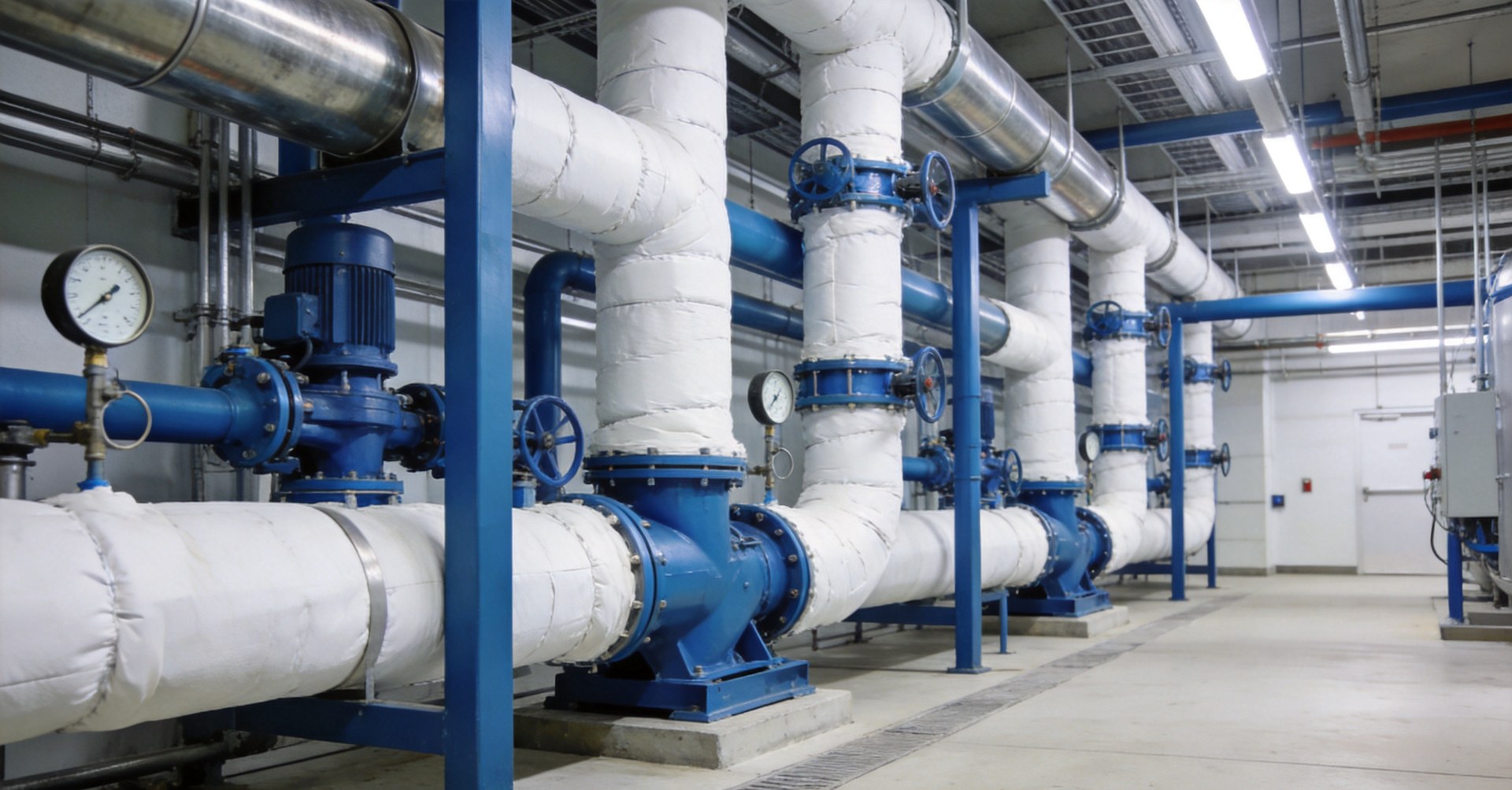
Building-services piping: hydronic mains, risers and plant rooms on a single steel network.
Four Loads That Decide an HVAC Pipe Spec
Velocity, chemistry, duty and install speed — in that order.
Four engineering loads decide every building-services pipe spec. Get any one wrong and the system fails early — so the rest of this page walks through how grade, schedule, treatment and code answer each one.
Velocity & erosion
Water above ~10 ft/s strips the protective oxide film from steel at bends and tees and adds flow noise. Below ~2 ft/s, air and sediment stop being carried and settle in the pipe.
- Key specifications
- • Steel cap ~10 ft/s
- • Sediment below 2 ft/s
- • 4 ft/100 ft friction target
Corrosion & treatment
Closed chilled loops corrode at 1–2 mpy with inhibitor; open tower loops run 3–5 mpy or worse — oxygenated, sunlit and biologically active. Wall allowance must follow the loop.
- Key specifications
- • Closed 1–2 mpy
- • Open 3–5+ mpy
- • MIC & under-deposit
Pressure & temperature
Chilled water at 100–150 psi, steam to 800 °F, thermal growth of 1.2 in per 100 ft on a 150 °F rise — wall, expansion loops and anchors all come from the same calculation.
- Key specifications
- • A53 Gr.B to 800 °F
- • 1.5× hydro test
- • Expansion per MSS SP-58
Schedule & labour
Construction programmes reward flame-free joining. Grooved couplings install 5–10× faster than welding and are visually inspectable — but only if the pipe is grooving-ready.
- Key specifications
- • Grooved 5–10× faster
- • Roll groove keeps wall
- • Sch 80 min threaded
Four Pipe Families in Every Building
Cooling, heating, plumbing and air — one supplier covers all.
From a district-cooling riser to a hospital steam main to a data-hall chilled-water loop, the same four families appear — each pushing a different parameter to the front.
Four building-service pipe families
Every MEP project runs the same four pipe families — this page covers all of them.
Where each pipe family fits
Click through to the detail cards below
Chilled & condenser
Closed chilled-water loops and open cooling-tower circuits. The largest-diameter water systems in the building and the most corrosion-exposed.
- Key specifications
- • ASME B31.9
- • 4–8 ft/s chilled
- • Open loop = treated
Heating & steam
LPHW / HHW heating water and low-pressure steam & condensate. Temperature drives the grade and the insulation package.
- Key specifications
- • ASTM A53 / A106
- • B31.1 for steam
- • To 800 °F
Domestic & risers
Potable hot and cold distribution and building risers. NSF-61-safe linings, galvanized or lined carbon steel, leak-tight for decades.
- Key specifications
- • NSF/ANSI 61 linings
- • Galvanized or FBE
- • 1.5× tested
Air & services
Compressed-air mains, instrument air and utility services. Moisture-carrying, so galvanized or internally coated to stop rust scaling into valves.
- Key specifications
- • Galvanized typical
- • Dry & instrument air
- • Leak-tested
Chilled & Condenser Water Systems
Closed loops save corrosion; open loops demand treatment — size for both.
Chilled and condenser water are sized by two limits at once: friction (the classic 4 ft of head per 100 ft target) and velocity. Below 2″ keep 2–4 ft/s; branch and riser runs sit at 4–7 ft/s; mains cap at 8 ft/s — and 10 ft/s is the absolute steel ceiling before erosion-corrosion and noise take over. Condenser water is a different animal: an open tower loop that scrubs air, oxygen and nutrients, so it needs a larger corrosion allowance (1/8 in vs 1/16 in per ASME B31.9 practice) and a serious water-treatment programme.
Chilled & condenser water design limits
Per ASME B31.9 and hydraulic practice
| Parameter | Chilled water (closed) | Condenser water (open) |
|---|---|---|
| Velocity | 4–8 ft/s (2–4 on small pipe) | 5–10 ft/s |
| Corrosion allowance | 1/16 in (1.6 mm) | 1/8 in (3.2 mm) or more |
| Typical corrosion rate | 1–2 mpy treated | 3–5 mpy treated, >10 untreated |
| Insulation | Closed-cell elastomeric foam | Usually none (outdoor: weatherproof) |
| Design code | ASME B31.9 | ASME B31.9 + AWWA C200 on large mains |
| Test | Hydro 1.5× design, 4 h | Hydro 1.5× design, 4 h |
Velocity limits by service
Above ~10 ft/s steel sheds its oxide film
Heating Hot Water & Steam Systems
A53 to 800 °F, A106 when the wall matters, B31.1 for steam.
Heating hot water and low-pressure steam are the temperature jobs. ASTM A53 Grade B serves to 800 °F (427 °C) and 150-psi-class steam comfortably; higher pressures step up to seamless ASTM A106 Gr.B. Steam mains are designed to ASME B31.1 (power piping) or B31.9 for building service, run at 80–120 ft/s so condensate is entrained rather than pooling, and are insulated with fiberglass or mineral wool — the pipe never sees the weather, the insulation system does.
Heating & steam pipe stack
ASME B31.1 / B31.9 · ASTM A53 / A106
| Service | Typical grade | Standard & notes |
|---|---|---|
| LPHW / HHW heating water | A53 Gr.B ERW (Type E) | ASME B31.9; 180–200 °F loops |
| LP steam ≤ 15 psig | A53 Gr.B Sch 40 | B31.1 / B31.9; slope back to trap |
| MP steam 15–150 psig | A106 Gr.B seamless | B31.1; schedule per pressure class |
| Condensate return | A53 Gr.B Sch 80 | Flash + two-phase; corrosion-watch duty |
| District heating main | API 5L / A53 welded | Insulated & jacketed or site-insulated |
Why grade matters at temperature
Strength drops as temperature rises
- • A53 Gr.B: Fy 240 MPa, Fu 415 MPa at room temp
- • Seamless A106 Gr.B for wall-critical steam
- • Thermal growth 6.5 × 10⁻⁶ in/in/°F — design loops
- • Weld E7018 fills; preheat rarely needed (<19 mm)
Steel Grades for Building Services
A53 Gr.B by default, A106 for steam, A795 for fire.
One grade dominates the market: ASTM A53 Grade B. It comes electric-resistance-welded (Type E, the economical default), seamless (Type S) or furnace-welded (Type F, galvanized small pipe), black or hot-dip galvanized, and it is the specified material behind most chilled-water, heating and fire systems in commercial construction. A135 and A795 are the ERW and fire-protection siblings; EN 10255 and JIS G3454 are the European and Japanese equivalents.
Grade selection table
ASTM A53 / A135 / A106 / A795 · EN 10255 · JIS G3454
| Grade | Fy min (MPa) | Typical use in HVAC |
|---|---|---|
| ASTM A53 Gr.B (Type E) | 240 | Chilled, heating, domestic — the MEP workhorse |
| ASTM A53 Gr.B (Type S) | 240 | Seamless where the weld seam is unwelcome |
| ASTM A53 Gr.A | 205 | Lighter duty, bending & coiling work |
| ASTM A135 Gr.A / Gr.B | 205 / 240 | ERW schedule-pipe for fire & water |
| ASTM A106 Gr.B | 240 | High-pressure steam & hot water (>150 psi class) |
| ASTM A795 | 205 / 240 | Fire-sprinkler pipe (NFPA 13), black or galvanized |
| EN 10255 (S195T) | 195 | European threaded & grooved services pipe |
| JIS G3454 STPG370 | 215 | Japanese pressure service equivalent |
A53 Gr.B quick facts
The default specification on most drawings
- • C ≤ 0.30%, Mn ≤ 1.20% — welds without preheat
- • 100% hydro test on every length
- • NDT of ERW seam required by the standard
- • Black or hot-dip galvanized (Zn per A153)
- • NPS 1/8″ – 26″, Sch 10 – 160
- • Service range -20 °F to 800 °F
Schedule Walls: 10, 40, 80 and Beyond
Light wall for grooved speed, heavy wall for threads and chemistry.
Schedule is the wall story of HVAC. Most hydronic systems live on Sch 40 or lighter Sch 10 when grooved or welded; the industry’s quiet failure is Sch 40 threaded pipe in open condenser water — at today’s corrosion rates a threaded Sch 40 joint can be a 15-year item. Threaded steel should be Sch 80 minimum, and corrosion allowances from ASME B31.9 (1/16 in closed, 1/8 in open) apply on top of the pressure wall.
Schedule 40 vs Schedule 80 wall
ASME B36.10 walls — threaded service demands Sch 80 minimum.
Schedule selection
Match wall to joint type and loop chemistry
| Schedule | Where it is used | Watch-out |
|---|---|---|
| Sch 10 | Grooved & welded chilled water, sprinkler mains | Light wall — not for threading |
| Sch 40 (STD) | Threaded ≤2″, welded mains, general duty | Thin for threaded open loops |
| Sch 80 (XS) | Threaded condenser water, steam, buried | Specified where corrosion bites |
| Sch 160 / XXS | High-pressure headers, special services | Cost jumps — confirm need |
Corrosion & Water Treatment
Closed loops inhibit; open loops treat, filter and thicken.
Closed chilled loops are gentle: with nitrite or molybdate inhibitor maintained, carbon steel sits at 1–2 mpy and a Sch 40 wall lasts decades. Open condenser water is the opposite — the cooling tower is an air washer that feeds the loop oxygen, dirt, sunlight and nutrients. Untreated rates can exceed 25 mpy, and microbiologically influenced corrosion (MIC) and under-deposit attack concentrate the loss in dead legs and bypass lines. Pipe selection follows: heavier wall, side-stream filtration, and Sch 80 for any threaded section.
Corrosion rates: closed vs open loops
Treatment quality decides wall life — open loops bite hardest.
Water-treatment programme targets
Coupons minimum 90 days; investigate >8 mpy
| Programme | Dose / target | Loop type |
|---|---|---|
| Sodium nitrite | ≥ 700 ppm nitrite, test weekly | Closed chilled / heating |
| Sodium molybdate | 200–800 ppm as MoO4 | Closed, demin water make-up |
| Azole (copper guard) | Film-forming, blends with inhibitor | Closed, mixed metal |
| Biocide + blowdown | Oxidizing / non-oxidizing rotation | Open condenser towers |
| Filtration | Side-stream on bypass & dead legs | Open loops (deposits) |
Galvanizing, Linings & Insulation Coordination
Zinc for moisture, NSF linings for potable, the right jacket for steam.
Where water or moisture is constant — domestic risers, compressed-air mains, exposed roof pipework — galvanizing is the low-cost insurance. Hot-dip galvanized pipe per ASTM A53 (zinc coating per ASTM A153, typically 85–100 µm) resists atmospheric and potable-water attack; internally, cement mortar or epoxy linings carry NSF/ANSI 61 listing for potable service. Fire sprinkler systems add their own rulebook (NFPA 13 materials, ASTM A795). Externally buried sections step up to FBE or 3PE, exactly like the utilities.
Protection systems by service
Galvanize for air & water, line for potable, coat for soil
| Protection | Thickness / spec | Best for |
|---|---|---|
| Hot-dip galvanized | A153 Zn, ~85–100 µm | Domestic water, air, exposed pipe |
| Cement mortar lining | 3–6 mm, AWWA C205 | Potable & raw water mains (NSF 61) |
| Liquid epoxy (C210) | 250–500 µm | Potable tanks, fittings, repairs |
| FBE (C213) | 300–450 µm | Buried sections, treated water |
| 3PE (ISO 21809-1) | 2.5–4.0 mm | Buried mains in aggressive ground |
| Shop paint / epoxy | 80–120 µm DFT | Indoor exposed mechanical rooms |
Insulation coordination
The coating under the insulation matters too
- • Chilled water: closed-cell elastomeric + vapour barrier
- • Steam: fiberglass / mineral wool with jacket
- • Hangers: MSS SP-58, high-density inserts
- • Outdoor condenser: weatherproof, no vapour drive
Grooved, Threaded, Welded — Picking the Joint
Programme speed is a pipe-end decision made at the mill.
Joining is where HVAC programmes are won. Grooved mechanical couplings — roll-grooved ends, elastomeric gasket, two-bolt housing — install up to ten times faster than welding, tolerate vibration and seismic movement, and can be verified visually at the bolt pads. One documented project with 120+ couplings cut man-hours from 2,000 to 740. Threaded work stays below 2″; welding holds the structural and buried jobs. All three need the right pipe end — so order grooving-ready or bevelled ends from the mill.
Joining methods by pipe size
Grooved dominates modern installs; threads stay small; welds stay structural.
Joint selection
Speed, size and duty decide
| Method | Size range | Strength of the choice |
|---|---|---|
| Grooved coupling | ½″ – 24″ | 5–10× faster than welding, flame-free, visual check |
| Threaded (NPT) | ≤ 2″ | Fast and cheap; Sch 80 minimum in water duty |
| Butt-weld | 2″ & up | Strongest, permanent; labour + fire watch |
| Flanged | 4″ & up | Equipment breaks & valves; alignment-sensitive |
| Press / crimp | ≤ 4″ | Flame-free small-bore; limited to listed systems |
Design Codes & Standard Stacks
B31.9 for water, B31.1 for steam, NFPA 13 for fire.
Building-services pipe answers to a short stack of codes: ASME B31.9 governs the water and air systems, B31.1 takes over for steam, NFPA 13 owns the sprinkler network, and ASME B36.10M defines the NPS / schedule dimensions underneath. Hangers, zinc coatings and potable linings carry their own standards. On the hydrostatic test — 1.5× design pressure held 4 hours — B31.9 is the clause most specs quote.
Common code stacks
Pick the service first, the code second
| Code | Scope |
|---|---|
| ASME B31.9 | Building services piping (chilled, heating, air, water) |
| ASME B31.1 | Power piping — steam & condensate |
| NFPA 13 | Sprinkler systems & their pipe (A795) |
| ASME B36.10M | Pipe dimensions — NPS, Schedule walls |
| MSS SP-58 | Hangers & supports for insulated lines |
| ASTM A153 / EN ISO 1461 | Zinc coating after galvanizing |
| NSF/ANSI 61 | Potable-water contact linings |
| EN 10255 / JIS G3454 | European / Japanese services pipe |
Standards flow
Product → design → protect → verify
A Six-Step Specification Guide
From service to test certificate — the spec the mill needs.
Define the service
Chilled, condenser, heating, steam, domestic or air — and the loop type: closed, open or potable.
Pick the grade
ASTM A53 Gr.B for nearly everything; A106 Gr.B for steam; A795 for sprinklers; EN 10255 for EU specs.
Set the schedule
Sch 10 grooved / welded; Sch 40 threaded small-bore; Sch 80 for threaded water and corrosive duty.
Size velocity & wall
4–8 ft/s chilled, 5–10 condenser; +1/16 in closed, +1/8 in open corrosion allowance.
Choose protection
Black for treated closed loops; galvanized for air & potable; FBE / 3PE for buried; NSF 61 linings.
Confirm codes & test
B31.9 / B31.1 / NFPA 13; MSS SP-58 hangers; hydro 1.5× for 4 h; MTC per EN 10204.
Service-to-Pipe Quick Matrix
Building-services pipe is chosen by system duty first and steel grade second. This matrix condenses the four pipe families described above into the default answers most contractors expect.
| System | Default pipe | Default wall | Notes |
|---|---|---|---|
| Chilled water (closed loop) | Black ERW (A53 Gr. B / A135 Gr. A) | Sch 10 welded; Sch 40 threaded ≤ NPS 2 | Closed loop plus water treatment controls corrosion |
| Condenser water (open loop) | Black ERW | Sch 40 preferred | Continuous oxygen ingress raises corrosion — bigger margin |
| Heating hot water (≤ 120 °C) | Black ERW; seamless above | Sch 40 | Watch oxygen pickup with fresh-water make-up |
| LP steam and condensate | Seamless A106 Gr. B | Sch 40 / Sch 80 | Condensate corrosion and thermal cycling |
| District energy tie-ins | Pre-insulated EN 253 carrier pipe | Per EN 253 | Bonded PUR core with HDPE casing and leak detection |
Note: The matrix is a starting point, not a code: the mechanical engineer of record sizes the actual wall from the design pressure and temperature — exactly the wall-sizing logic covered in the schedule section above.
Quality Assurance: What We Test, and Why
Every line on the MTC ties back to a clause in the spec.
Dimensional & wall
OD ±1%, wall per ASME B36.10 schedule, straightness ≤0.2% L
- Key specifications
- • ASTM A53 § / ASME B36.10M
Chemical analysis
C ≤ 0.30%, Mn ≤ 1.20%, P & S limits per grade
- Key specifications
- • ASTM A53 / A751
Tensile & yield
Gr.B: Fy 240 MPa min, Fu 415 MPa min, elongation per standard
- Key specifications
- • ASTM A53 / A370 / EN ISO 6892-1
Hydrostatic test
100% of lengths tested at the mill; system test 1.5× design, 4 h
- Key specifications
- • ASTM A53 / ASME B31.9
Weld-seam NDT
Electric test (ERW) of the seam per standard
- Key specifications
- • ASTM A53 Type E requirements
Zinc coating
Coating weight / thickness per A153; adhesion & uniformity
- Key specifications
- • ASTM A153 / EN ISO 1461
Groove & end prep
Roll / cut groove dimensions per coupling maker; bevel per AWS
- Key specifications
- • MSS SP-53 / coupling standard
MTC & marking
Heat number, grade, type, size, standard stamp, EN 10204 3.1 cert
- Key specifications
- • EN 10204 / ASTM A53 §
Standards & Certification Map
A complete building-services pipe specification is a stack of standards — from the product spec through design code, protection system, joining practice and documentation. The five columns below are the ones our mill & engineering team reach for first; project-specific clauses (seismic, healthcare, potable) are added on top.
Product
- ASTM A53 (Type E/S/F) — Black & galvanized services pipe, Gr.A/B
- ASTM A135 — ERW schedule pipe for water & fire
- ASTM A106 Gr.B — Seamless for steam & hot water
- ASTM A795 — Fire-sprinkler pipe (NFPA 13)
- EN 10255 / JIS G3454 — EU / JP services pipe equivalents
Design codes
- ASME B31.9 — Building services piping
- ASME B31.1 — Power & steam piping
- NFPA 13 — Sprinkler systems
- ASME B36.10M — NPS & schedule dimensions
- MSS SP-58 — Hangers & supports
Protection
- ASTM A153 / EN ISO 1461 — Galvanizing after fabrication
- AWWA C205 / C210 / C213 — Cement / epoxy / FBE linings
- NSF/ANSI 61 — Potable-water contact
- ISO 21809-1 (3PE) — Buried external coating
- AWWA C200 / M11 — Large condenser & water mains
Welding & joining
- AWS D1.1 / ASME IX — Weld procedures & qualification
- MSS SP-53 — Grooving practice
- Coupling maker specs — Groove profile & gasket class
- E7018 / ER70S-6 — Filler metals for A53 Gr.B
Testing & docs
- ASTM A53 hydro — 100% mill hydro on every length
- ASME B31.9 § — 1.5× design pressure, 4 h
- ASTM A370 / A751 — Mechanical & chemical test methods
- EN 10204 3.1 / 3.2 — Mill test certificate
- ISO 9001 — Quality system
Frequently Asked Questions
Six questions we hear most often from MEP engineers, mechanical contractors and procurement teams.
What pipe should I use for chilled water — and which schedule?
ASTM A53 Grade B is the default. Use Sch 10 where joints are grooved or welded, Sch 40 for general duty and small threaded runs, and Sch 80 wherever threaded pipe sees open (tower) water. Add the ASME B31.9 corrosion allowance — 1/16 in closed loop, 1/8 in open.
Why does condenser water eat pipe faster than chilled water?
The cooling tower aerates, sunlights and feeds the loop. Treated open loops run 3–5 mpy against 1–2 in closed systems; untreated or MIC-affected loops can exceed 25 mpy. Filtration, biocide rotation and heavier wall answer it.
Is Sch 40 threaded pipe acceptable in condenser water?
It is the industry’s classic hidden failure. At modern corrosion rates a threaded Sch 40 joint in open water is a ~15-year item. Specify Sch 80 minimum for threaded sections, or go grooved or welded and keep Sch 40 walls for pressure only.
Can I use one pipe grade for steam and chilled water?
Usually yes — ASTM A53 Gr.B covers -20 °F to 800 °F and both services. The difference is the code around it: steam falls under ASME B31.1, water under B31.9, and the schedule, insulation and expansion design follow their rules.
Why specify grooved couplings instead of welding?
Speed and safety: roll-grooved couplings install 5–10× faster, need no hot work or fire watch, absorb vibration and seismic movement, and are verified visually at the bolt pads. The roll groove does not remove metal, so the wall stays intact.
What documentation comes with an HVAC pipe delivery?
EN 10204 3.1 mill certificate as standard (3.2 on request), heat-number traceability, mill hydrostatic records, zinc-coating certificates for galvanized lots, and groove-dimension reports where pipe is supplied grooving-ready.
What is the difference between STD, XS and Sch 40 / Sch 80?
For the common small sizes, STD equals Sch 40 and XS equals Sch 80 in wall thickness; above roughly NPS 8–10 the schedule numbers diverge and the designators stop being interchangeable. Always confirm the actual wall in millimetres on the datasheet rather than trusting the label.
Do I need dielectric isolation between steel and copper?
Wherever copper connects into steel headers, galvanic coupling drives the steel side to corrode — usually right at the joint. Use dielectric unions or flanges at make-up and equipment connections. Inside a closed, properly treated loop with consistent metallurgy some engineers omit them, but then the water chemistry has to be actively managed.
Why Buyers Choose CREATEEL for HVAC Pipe
Grade + schedule + protection + code, delivered from one mill.
Mill-direct, full catalogue
One contract covers A53 / A135 black & galvanized, A106 seamless, A795 fire pipe and the large diameter AWWA / API mains — not re-routed through separate stockists.
Schedule & end prep ready
Sch 10 – 80 stocked and rolled-groove, threaded or bevelled ends supplied from the mill — so the contractor installs instead of re-prepping.
Coating & lining integration
Galvanizing, FBE, cement mortar and NSF 61 epoxy linings are applied on the same yard as the mill — single quality record, holiday-tested before shipment.
Velocity-aware engineering
We size wall against the real loop: 4–8 ft/s chilled, 5–10 open, with B31.9 corrosion allowances — not a one-size catalog number.
Code-ready packages
ASME B31.9 / B31.1, NFPA 13, ASME B36.10M and MSS SP-58 referenced on every datasheet, with weld procedures qualified to AWS D1.1 / ASME IX.
Traceable documentation
EN 10204 3.1 certificate, third-party 3.2 on request, full heat-number, hydro and coating records for the whole delivery.
Related CREATEEL Products
Every building-services project is backed by the mill’s wider steel-pipe catalogue.

PU Foam Insulated Pipe
Steel carrier pipe with rigid PU foam and HDPE jacket per EN 253 — pre-insulated district heating and cooling lines.
View product details →
ERW Steel Pipe
½″–24″ HFW — the A53 / A135 workhorse for hydronic and fire systems.
View product details →
Galvanized Steel Pipe
Galvanized pipe to ASTM A53 / EN 10255 — plant rooms, risers and exposed services.
View product details →
Seamless Steel Pipe
The full seamless range — hot-finished and cold-drawn, EN 10204 3.1 / 3.2 certified.
View product details →
LSAW Steel Pipe
UOE / JCOE heavy-wall 16″–56″ — large plant-room and district mains.
View product details →
Butt-Weld Pipe Elbows
Butt-weld elbows and fittings to ASME B16.9 for hydronic, fire-water and power-piping circuits.
View product details →Ready to Specify HVAC Pipe?
Send us the service, the loop type and the codes — we will come back with a mill-direct quote, the grade and schedule proposal, and the coating / lining scope for the building’s design life.
 [email protected] |
  +86 15602135951 |
  WhatsApp Available